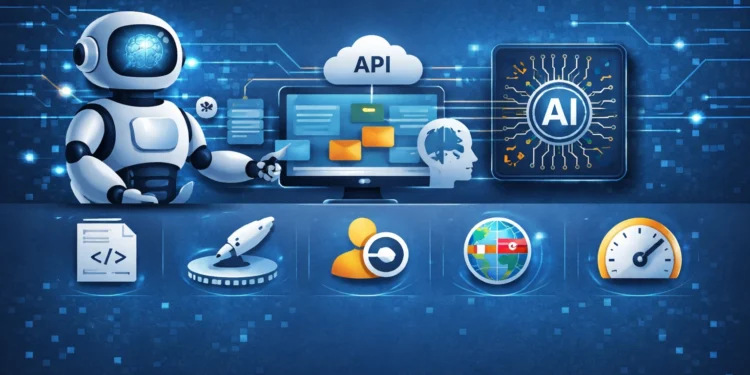



The future of content creation, presentation and management for organizations is increasingly artificial intelligence. Automated content generation, predictive personalization, predictive engagement, semantic tagging and other AI-driven tools are becoming staples within the digital toolbox to ensure organizations keep up with web-based practices. However, AI is only as good as the content infrastructures that power it.
AI relies heavily on content being properly structured, tagged, and accessible. Therefore, the intersection of AI and content performance relies on the support of other advanced technologies specifically, headless CMS architecture. Headless systems allow for content decoupling and structuring to provide the API-accessible data that AI technologies need to create seamless workflows. The following article discusses how the headless CMS supports AI technologies and substantiates AI-assisted workflows for scalable, efficient, and future-proven content performance.
Providing a Machine-Readable Framework for Automation
Wherever content is unstructured, it’s more of a challenge for machine interpretation and automated processes. If content is part of a template rather than distinct designations, inconsistencies arise and automation becomes less efficient. Get started with Storyblok to take advantage of structured content models that enable better automation and consistency. Headless CMS systems allow for structure that’s uniform with distinct fields and content types.
These structures create definitions for what’s adjacent to what titles and subtitles, metadata, and product attributes, including taxonomies. Therefore, AI trained in content generation knows how to access, interpret, and reconfigure for generated outputs. They can create summaries, metadata, and alternative text based on what’s provided.
Machine-readable architecture safeguards both AI processes in practice and the content they draw inspiration from, thus making automation more accurate without the editorial back-and-forth.
Automating Content Creation with AI Systems
AI workflows often promote automated content creation from product descriptions to summaries to alternative headlines. In a headless CMS, this is facilitated much more easily because the fields are exposed via API.
Instead of generating a document and bringing it into the headless CMS or using a headless CMS sub-platform to generate text, automation allows for generative text to be created through AI in specific content fields. This means internal review and approval processes exist in already designated workflows without extensive effort.
At the same time, because presentation is separate from content creation within headless systems, Ai-generated variations may be tested across multiple channels without fear of duplicative efforts.
This saves time with editorial governance still in place. Content creators can focus their efforts on AI-generated versions that work instead of concept creation. Over time, blending the best of both worlds in structured environments fosters faster production without sacrificing quality.
Facilitating AI-Generated Personalization at Scale
Personalization is one of the most potent applications of AI systems in digital experiences. Based on user behavior, actions taken, intent, and context clues, AI generates personalized experiences for its audiences. Yet to do this effectively at scale requires modular structures that can be recomposed easily.
Headless CMS systems provide this modular ability as the structure of system components like banners, recommendations, and feature highlights must all come with metadata tags that make presentation possible but distribution optional. With signals from users, AI can pick and choose which modules to present for customized experiences.
This solution is effective at scale because it prevents duplicative pages from existing everywhere. Instead, a unique experience can emerge from structural components that are merely accessible through tagging as a library of reusable elements. This ensures personalization scalability while still adhering to established governance over time.
Enabling AI-Powered Accessibility Through Semantic Enrichment
Another way that AI-assisted workflows transform content generation is through semantic tagging and classification to improve accessibility. Machine learning models can better analyze text and then recommend tags, categories or topic links that provide additional nuance to search and internal linking.
The headless CMS structure substantiates these recommendations. Tagging fields, taxonomies and predefined metadata schemas ensure that AI-generated classifications exist in the environment with any relevant content application.
When semantic enrichment is integrated into headless CMS workflows, organizations benefit from user-facing search tools as well as internal management. More nuanced tagging increases findability and reduces manual effort of assignment.
Enhancing Multilingual AI Workflows
AI translation tools have become far more advanced over time but still require segmentation (i.e. field by field instead of whole page) to be most effective. Headless CMS enhance multilingual AI workflows because the content fields can exist within the same entry but separated from one another.
AI translation can read a single field prompting it to return its translation back into the correct field. Reviewers can then assess results within the same level of approval workflow. Because there is no duplication, the source and localized versions also maintain connection.
As organizations scale into more marketplaces, AI assisted translation connecting to headless structure allows for expedited translation without sacrificing accuracy or governance.
Facilitating Analytics and Predictive Optimization Efforts
AI-driven analytics can determine content options for optimization based on engagement metrics. Predictive AI can determine which headlines work best or what could be changed based on user behavior patterns. In all cases, these systems require consistent data structures to work best.
Headless CMS provide standardized components across channels. Each modular part exists with its own identifier and metadata structure, allowing AI systems to gauge performance at the micro-level and generalize findings for macro-level adjustments on other channels.
When content architecture supports predictive optimization efforts, organizations avoid working from disparate systems. Instead, insights based on structured findings help improve strategy over time.
Governance Strengthening in an AI-Assisted World
AI-augmented content introduces new governance concerns. Automated, generated, and personalized efforts require adherence to brand parameters, similar to regulations. Without the added structure, AI may not conform to expectations.
Headless CMS establishes governance as part of the process. Stages of approval, version history and granular permissions ensure that what AI generates doesn’t go live without human checks. Structured configurations maintain compliance with tone, style and vocabulary.
Such governance gives organizations the ability to empower AI tools without fearing that human oversight may be replaced. AI becomes a speedster instead of an industrial replacement when it’s virtualized in an organized space. A structured system ensures that automation fulfills, and doesn’t disrupt, governance.
Supporting AI Adaptation with a Decoupled Architecture
AI is continually evolving. Organizations need to support their infrastructure for new solutions and algorithms. Decoupled headless CMS architecture offers the adaptable infrastructure necessary for ongoing evolution.
By delivering content through APIs, access to new AI solutions is seamless without needing to redefine what the centralized repository holds. Whether new suggestions in natural language processing or predictive offerings through personalized recommendations, organizations can connect AI solutions to structured datasets.
Such access preserves long-term value. Instead of needing to overhaul operations for each new AI advancement, organizations extend their existing ecosystem. Since decoupled options exist, AI adaptation is ensured to be scalable.
Human-in-the-Loop Workflows Supported by a Headless CMS
Although AI can expedite asset creation and optimization, few entirely autonomous elements align perfectly with tone, compliance measures, and nuance for strategic intent. Human-in-the-loop environments support those AIs produce drafts that are vetted and approved, ensuring quality before publication. A headless CMS helps facilitate this approach.
As content becomes structured within a defined process, AI-generated drafts can be plugged into fields and set up through editorial channels for review. Versioning allows organizations to recognize what suggestions were brought into the fold from previous iterations. Editors maintain their rights while benefitting from Ai time-saving suggestions.
This structure allows trust to blossom within AI solutions since it’s not merely seen as a replacement for content teams but instead, a productivity-enhancing solution that keeps operations streamlined. Over time, organizations develop scalable processes where human insight and machine intelligence work in tandem.
Support Real-Time Content Adaptation via AI Signals
Content systems that rely on AI support increasing levels of real-time behavioral signals, from content adjustments based on actions to situational awareness based on location or embedded content. Since this occurs in the moment and requires modular, API-accessible components that fit together in an instant, their supporting infrastructure must also reflect this modularity.
Headless CMS systems support this adaptability. With structured modules accessible due to tag-based metadata, AI can implement recommendations based on flexible impressions. From shifting a product module focus based on supply chain insights to requiring more data-driven calls to action due to increased click-through patterns, the headless CMS supports reconfiguration in real-time.
Adaptation in real-time, therefore, supports relevance without requiring the re-construction of an entire page. By accessing modular components structured for engagement and accessibility, organizations can provide contextually appropriate responses at scale without breaking site integrity.
Facilitate AI-Led Content Lifecycle Management
AI and content lifecycle management are connected; AI can help find outdated content that needs new assets, predict opportunities for refreshes or determinations of expiration. In all cases, actionable insights come from when such information is correctly categorized and trackable.
The headless CMS provides the baseline structure for lifecycle management automation. With metadata fields capable of noting date published, performance statistics and intervals for review, AI tools can evaluate this structured information to confirm when something needs a refresh or is underperforming enough to be flagged.
Therefore, when organizations access the benefits of AI for content development, they simultaneously improve content performance to reflect strategic initiatives. Gone are the days of manual audits; with data-driven content organizations can proactively pursue ideal projects. Thus, structured automation improves longevity for all parties content owners and consumers alike over time with fewer risks of decay.
Establish a Framework for High-Quality Generative and Predictive Models Over Time
Generative AI and predictive modeling may take on increasingly complex forms and require a consistent baseline of high-quality information over time. The best places to operate under this reliable framework are often headless CMS systems.
Companies can lend structured content repositories as reliable sources for training responsible AI programs. Predictive models looking for trends in engagement require consistent metadata and accessible components for accurate findings. Generative systems can refer to structured attributes as accessible realities over assumed registrations.
By keeping a clear and consistent accessibility system, organizations reduce the risks associated with misinformation down the line and the inconsistency among AI-generated alternatives. Therefore, a reliable foundation opens up credibility while innovative possibilities flourish. When access to intelligent systems becomes more available, the power of headless CMS architecture keeps everything grounded in a structured system of reliable proportions.
Where Innovation Meets Governance
As AI capabilities increasingly expand, organizations must bridge the gap between innovation and governance. Automated content generation, predictive recommendations, and dynamic personalization present levels of operating complexity that require an empowered, governed foundation. Without it, AI in the wild may lead to compliance challenges, inconsistencies, or fragmented messaging across channels.
A headless CMS serves to bridge this gap. The very nature of a headless CMS puts governance at the heart of AI-enhanced operations. Structured content models render standardized fields, role-based permissions and approval processes prevent pre-approved AI content from being published without review, and audit trails and version history highlight AI contributions and editorial changes to AI suggestions for contextual accountability.
Therefore, enterprises can embrace the latest in innovative AI while making sure they’re not missing out on brand or regulatory standards. AI is no longer a secondary layer in need of additional innovation; instead, it grows alongside governed operations and, over time, becomes an integral component of responsible, enterprise-ready AI adoption supported by a substantial headless CMS foundation.
Conclusion
AI-assisted workflows represent the future of content operations based on efficiency, personalization and optimization, but those benefits are only as good as the structure and flexibility of the underlying content foundation. Headless CMS architecture supplies the clarity, modularity and API-driven accessibility that AI technologies rely upon.
From machine-readable, composable content structures and dynamic, data-driven personalization to multilingual approachability and governance embedded in workflows, a headless CMS empowers organizations to scale AI with responsibility. It’s the best of both worlds to take digital operations to a new level of adaptive, data-driven comprehension.
In a world where AI is the innovative future of content operations, a headless CMS isn’t supportive infrastructure. It’s the backbone that supports intelligent scalability.