


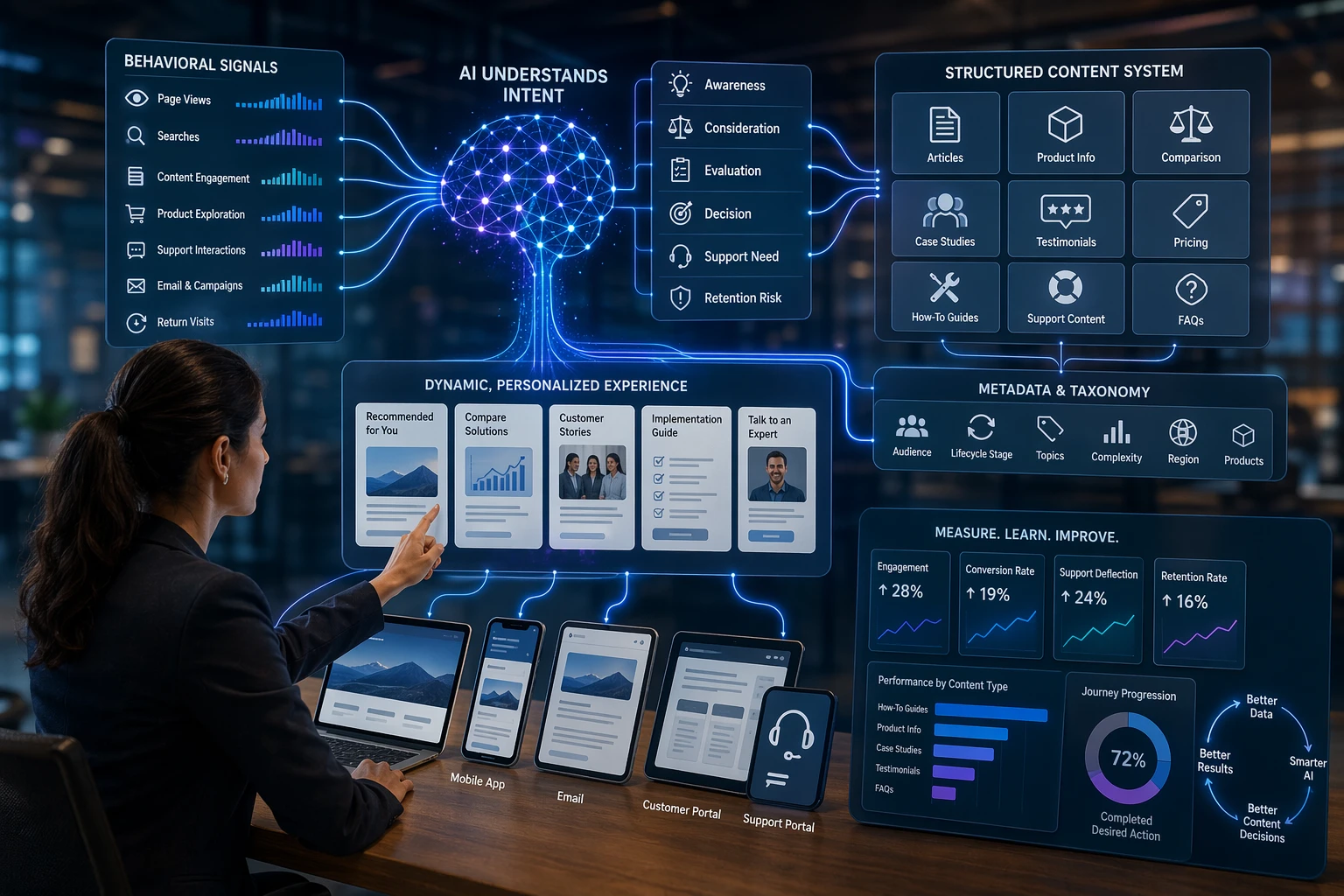
Behavioral personalization has become one of the most important ways for businesses to improve digital experiences. People no longer expect to be treated as anonymous visitors who all see the same homepage, the same recommendations, and the same next steps. They expect digital platforms to respond to what they do, what they explore, what they ignore, and what they seem to need in the moment. At the same time, businesses want personalization to be scalable. They want it to work across websites, apps, portals, and support environments without forcing teams to manually create endless variations of every asset.
This is where AI and structured content systems work especially well together. AI makes it possible to interpret user behavior quickly and identify likely intent, while structured content systems provide the content foundation that allows those insights to be turned into actual experiences. Without AI, personalization often remains limited to broad rules and static segments. Without structured content, AI has far less useful material to work with and much less flexibility in what it can deliver. Together, they create a model where user behavior can shape what content appears, how it is prioritized, and how the journey evolves in real time.
For businesses, this combination creates a more responsive and more efficient digital ecosystem. Content becomes easier to adapt to the user, and user behavior becomes easier to translate into meaningful action. Behavioral personalization is no longer just about showing different banners to different groups. It becomes a much deeper system for connecting intent with relevant information at the right moment. That makes it a major strategic capability for organizations that want to improve engagement, conversion, retention, and overall digital experience quality.
Why Behavioral Personalization Matters More Than Static Segmentation
Static segmentation can still provide value, but it often simplifies users too much. A business may divide visitors into categories such as new users, returning users, customers, or prospects, and then show each group a different version of the experience. This can be useful as a starting point, but it does not fully reflect how people actually behave. Two users in the same segment may have very different goals. One may be researching casually, while the other may be close to making a decision. One may need education, while the other needs reassurance or proof. Static segmentation struggles to reflect these differences because it depends on broad labels rather than live signals. This is one reason why conversations around Headless CMS vs WordPress have become more important, as businesses look for content systems that can better support more dynamic and responsive user experiences.
Behavioral personalization matters because it responds to what users are actually doing. It looks at actions such as page visits, repeated searches, time spent on certain topics, content progression, product exploration, support interactions, or navigation patterns to understand likely intent. That makes the experience far more relevant because the system is not only assuming who the user is. It is also reacting to what the user is showing in real time through behavior.
This shift has important business implications. A more responsive experience can reduce friction, improve journey flow, and increase the chance that a user reaches the next meaningful step. It can also make digital interactions feel more useful and less generic. In competitive digital environments, that difference matters more and more.
Why AI Is Essential for Behavioral Personalization at Scale
Behavioral personalization creates value, but it also creates complexity. Once a business starts looking at real user behavior, the number of possible signals and combinations grows quickly. A visitor may read three articles, compare two product pages, return from an email, search for a support topic, and browse pricing all in a short period of time. Interpreting that manually or through simple rules becomes difficult, especially when the business serves large audiences across multiple channels. This is why AI is so important. It can process patterns in behavior far faster and more consistently than traditional manual workflows or static rule sets.
AI helps identify what behavior likely means. It can recognize that repeated visits to certain categories signal strong interest, that some navigation patterns suggest evaluation-stage intent, or that a cluster of support interactions may indicate hesitation rather than satisfaction. It can also compare current users with broader behavioral patterns to estimate what kind of content may be most useful next. This allows personalization to move beyond rigid if-then logic and become more adaptive.
The value of AI is not that it replaces strategy. It is that it allows strategy to be executed with much greater scale and precision. Teams still decide what kinds of experiences matter, but AI helps determine how those experiences should respond to actual user behavior in a fast-moving environment. That makes behavioral personalization much more sustainable over time.
Why Structured Content Systems Are the Other Half of the Equation
AI can interpret user behavior, but it cannot deliver a meaningful experience unless the content system is capable of responding flexibly. This is where structured content systems become essential. A structured content system organizes content into defined types, fields, metadata, taxonomies, and relationships rather than storing everything as fixed pages. This makes content easier to retrieve, compare, reuse, and adapt across different channels and user contexts.
Without that structure, personalization remains limited. If content only exists inside static pages or inflexible templates, the system has very little room to change what the user sees in a precise way. It may be able to swap one full page for another, but it cannot easily assemble the right combination of educational text, proof points, product messaging, or support content for a specific situation. Structured content systems solve this by making the content modular. Different elements can be selected and delivered depending on what the user’s behavior suggests.
This means AI and structured content work together in a very direct way. AI determines what is likely relevant. The structured system makes that relevance operational by providing content in a form that can be dynamically delivered. Without structure, intelligence has limited practical impact. With structure, behavioral signals can turn into meaningful experience changes at scale.
Using Behavioral Signals to Understand User Intent
Behavioral personalization begins with understanding intent, and behavioral signals are one of the strongest indicators of that intent. A person who repeatedly explores introductory material is probably in a different mindset from someone who spends time in product comparisons or implementation resources. A user who moves into support content may need reassurance, clarity, or troubleshooting help. These signals are often more informative than static demographic categories because they reveal what the person is trying to accomplish in the moment.
AI is useful here because it can process these signals across many users and many sessions, identifying patterns that suggest likely needs. It can recognize when a sequence of actions often leads to conversion, when repeated revisits usually signal hesitation, or when certain combinations of behavior suggest a need for more advanced or more foundational content. This creates a richer picture of intent than simple analytics dashboards alone.
Once that understanding exists, structured content systems allow the business to respond intelligently. Instead of offering the same next step to everyone, the system can present the content that best fits the user’s current state. That is what makes behavioral personalization feel relevant. It is not only based on who the user is, but on what the user is communicating through behavior.
Metadata and Taxonomy Make Personalization More Precise
Behavioral data is powerful, but it becomes much more useful when combined with strong metadata and taxonomy. The system needs to understand not only what the user is doing, but also what each available content asset is designed to do. Metadata provides the descriptive context that helps classify content by purpose, topic, audience, lifecycle stage, complexity, region, or product association. Taxonomy ensures these labels are consistent enough for the system to rely on them.
This matters because behavior alone cannot always tell the engine what to serve. A user may show signs of deepening interest, but the system still needs to know which assets are suitable for evaluation-stage decision-making rather than early education. Another user may appear confused, but the engine needs to know which content assets are better suited for explanation, support, or reassurance. Metadata makes those distinctions much clearer.
In structured content systems, these descriptive layers can be embedded directly into the content model. That gives AI a much richer and more dependable set of content options to work with. Instead of matching behavior to content in a vague or improvised way, the system can make more precise decisions because it understands both sides of the equation: the user signal and the content role.
Behavioral Personalization Across Channels and Touchpoints
Modern journeys are rarely confined to one channel. A user may first interact with a brand on a website, continue through an email, return through an app, and later access a customer portal or support environment. Behavioral personalization becomes far more valuable when it can operate across those touchpoints rather than within one isolated channel. If personalization only works on a single website session, the broader journey still feels disconnected.
Structured content systems help solve this because they create one content foundation that can support multiple channels. The same content asset can appear in different forms across different platforms while still retaining its metadata and role in the wider content ecosystem. AI can then use behavioral signals collected across those channels to decide what should appear next, regardless of where the user is currently interacting. That creates a more continuous experience.
This continuity has both user and business value. Users feel that the system understands their journey rather than resetting every time they switch channels. Businesses gain a more coherent personalization strategy because they do not have to build separate logic and separate content versions for every platform. Behavioral personalization becomes much more powerful when it follows the user across touchpoints rather than stopping at channel boundaries.
Real-Time Adaptation Makes Personalization More Useful
One of the strongest advantages of combining AI with structured content systems is the ability to adapt in real time. A user’s needs can shift quickly during a session. Someone may arrive with broad curiosity, then show focused interest in a feature, and finally move toward support or reassurance content before taking action. If the experience stays static throughout that process, it loses the chance to be useful in the moment. Real-time adaptation helps close that gap.
AI can detect these changes in behavior as they happen and update the content experience accordingly. If the system notices that a user is moving deeper into a certain topic cluster, it can prioritize more specific resources. If the user appears stuck or repeatedly revisits a question, it can surface clarifying content or support-oriented messaging. Structured content systems make this possible because the relevant content blocks, messages, and recommendations are already available as modular assets rather than buried inside full-page templates.
This creates a more fluid experience. The content feels responsive instead of fixed. For users, this can reduce friction and improve confidence. For businesses, it can support stronger progression and more effective engagement. Real-time adaptation is one of the clearest ways behavioral personalization moves beyond basic targeting and starts becoming genuinely useful.
Measuring Whether Personalization Is Actually Working
Behavioral personalization should not be judged only by whether content changes dynamically. It should be judged by whether those changes improve meaningful outcomes. Businesses need to know whether personalization increases engagement, supports stronger journey progression, improves conversion quality, reduces support friction, or strengthens retention. This requires a content and analytics environment where personalized assets can be measured clearly and compared in relation to business goals.
Good measurement also supports continuous learning. AI models improve when they are fed better performance signals, and content teams improve when they understand which structured assets truly support better outcomes. This creates a feedback loop where personalization becomes more effective over time rather than remaining a static technical layer with unclear business value.