

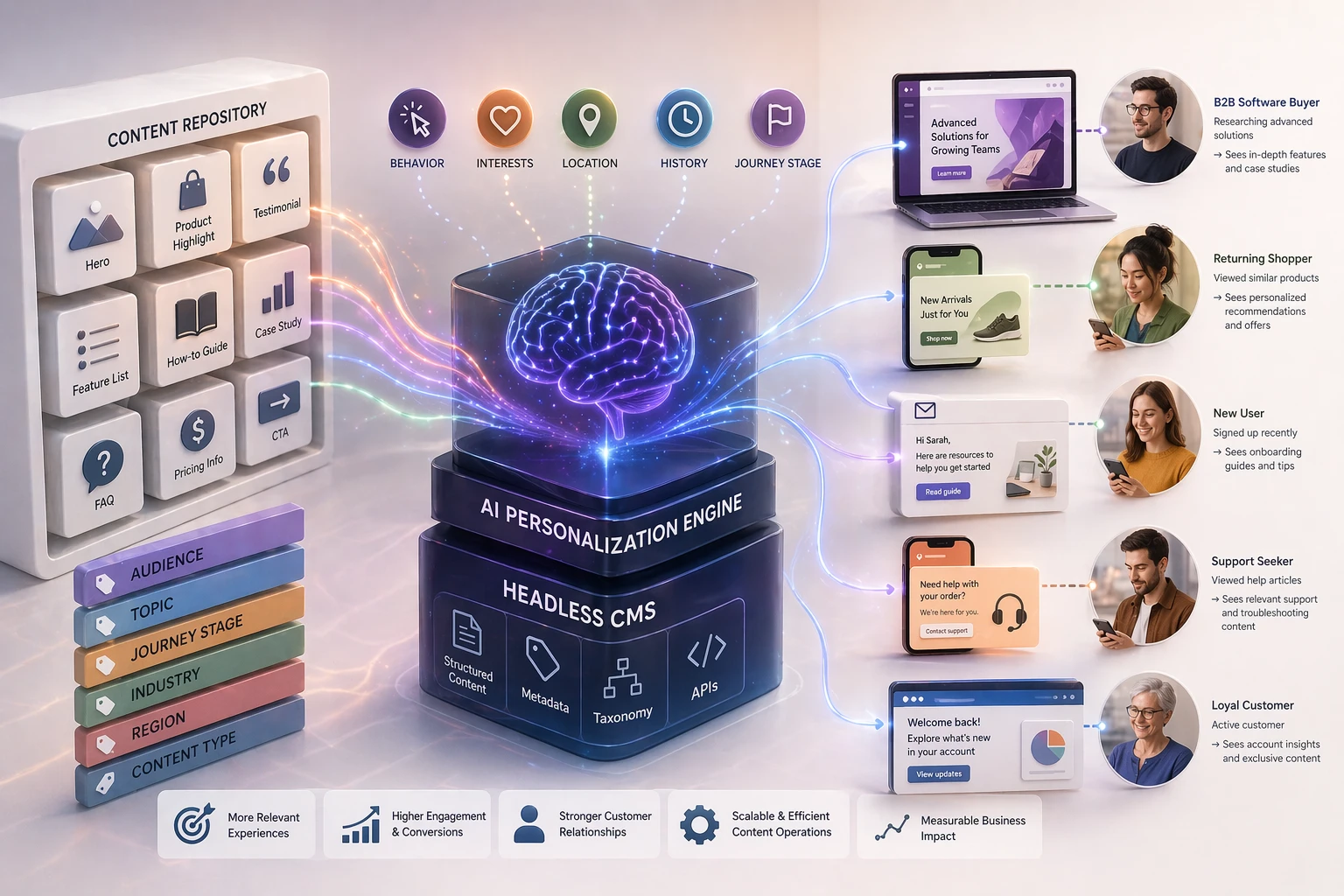
Personalization is no longer a nice addition to digital experiences. In many industries, it has become an expectation. Users want websites, apps, portals, and digital services to reflect their needs, interests, behavior, and stage in the customer journey. At the same time, businesses want personalization to be scalable. They do not want to create hundreds of manual content variations for every segment, channel, or moment. This is where the combination of AI and headless CMS becomes especially powerful. Together, they help businesses move beyond simple audience targeting and toward hyper-personalized content delivery that feels more relevant, more timely, and more useful.
A headless CMS creates the structural foundation for this shift by managing content as reusable, modular data rather than as static page elements. AI then builds on that foundation by analyzing user signals, identifying patterns, and helping determine which content should be delivered in a given context. Instead of showing the same message to every visitor, businesses can serve content that aligns more closely with behavior, preferences, intent, and real-time needs. This does not just improve engagement. It also supports better customer journeys, stronger conversions, and more meaningful digital interactions.
Hyper-personalization depends on more than technology alone. It requires structured content, consistent metadata, clear taxonomy, and a delivery system flexible enough to adapt content across many channels. That is why headless CMS plays such an important role. It gives AI the kind of content environment it needs to make smarter decisions. When these systems work together, businesses can create digital experiences that feel far more personal without making content operations slower or more complicated.
Why Hyper-Personalization Matters More Than Standard Personalization
Standard personalization usually works through broad rules. A certain audience segment sees one version of a page, while another segment sees a different one. This can still create value, but it often remains limited because it treats groups of users too generally. Hyper-personalization goes further by using more detailed signals to adapt content in ways that feel more specific to the individual or the exact moment. Instead of only recognizing that someone belongs to a broad segment, the system can respond to what they are doing right now, what they have viewed before, where they are in the journey, and what type of information they are most likely to need next. In this context, Headless CMS: A WordPress alternative becomes increasingly relevant for businesses that need more flexibility to support real-time, highly tailored digital experiences.
This matters because customer expectations have changed. People are now used to digital services that anticipate intent, recommend relevant information, and reduce friction. If a business continues relying only on static content or broad segmentation, the experience can feel generic and disconnected. Hyper-personalized content helps reduce that problem by making the interaction feel more responsive. A visitor researching a product for the first time should not necessarily see the same content as an existing customer returning for support or expansion-related information.
The business value is also significant. More relevant content can improve engagement, reduce bounce, support better lead quality, and increase the likelihood that users move to the next step. Hyper-personalization helps content become more useful because it connects delivery to context rather than relying only on broad assumptions.
Why Headless CMS Is Essential for Hyper-Personalized Delivery
A headless CMS is essential for hyper-personalized delivery because it allows content to exist independently from a fixed page layout. In traditional systems, content is often tied directly to templates, which makes it harder to separate one message, module, or content block from the page it belongs to. That limits flexibility because the system has fewer ways to dynamically select and combine content for different users. A headless CMS solves this by treating content as structured, reusable assets that can be delivered through APIs to any interface or channel.
This means a business can manage content at a more modular level. Headlines, summaries, support blocks, product highlights, testimonials, educational snippets, and calls to action can all be stored separately and used in different combinations. That makes it much easier for AI to choose what should be shown in a particular moment. Instead of being restricted to swapping out entire pages, the system can adjust meaningful parts of the experience based on user data and journey context.
This flexibility is what makes real hyper-personalization possible. The business is no longer locked into static publishing logic. It has a content foundation that is ready to support intelligent assembly and delivery across websites, apps, customer portals, email experiences, and other digital touchpoints. Without this structure, personalization often remains too shallow to be truly effective.
How Structured Content Makes AI Personalization Smarter
AI can only personalize content well if the content itself is structured clearly enough to be understood and selected intelligently. A headless CMS supports this by organizing content into defined content types, fields, metadata, and relationships. Instead of viewing content as one large block, the system can distinguish between a title, summary, category, audience tag, product reference, journey stage, or related asset. This gives AI much more context when deciding what to recommend or display.
For example, if the system knows which content assets are educational, which are promotional, which are designed for onboarding, and which are meant for more advanced users, AI can make much more informed choices. It can analyze user behavior and match it to content attributes more precisely. A user showing curiosity about implementation details might receive practical setup content rather than broad awareness messaging. Another user comparing options may be shown proof-driven resources such as case studies or feature breakdowns.
This is why structured content is so important. AI is not creating relevance from nothing. It is working from the clarity already built into the content model. The better the structure, the better the matching. That allows personalization to move beyond generic rules and become more context-aware, which is exactly what hyper-personalization requires.
Using Behavior Signals to Match the Right Content to the Right User
Behavior signals are one of the strongest inputs for hyper-personalized content delivery. These signals can include page views, navigation patterns, repeated visits, search behavior, feature usage, engagement depth, content downloads, and many other forms of interaction. AI can use these patterns to infer what a user is likely interested in or where they may be in the journey. However, this only becomes valuable when the system can connect those signals to content that is actually relevant.
A headless CMS helps here because it provides a structured inventory of assets that can be selected in response to those signals. If a user repeatedly explores beginner-level resources, the system can continue surfacing educational content that reduces friction and builds confidence. If another user consistently engages with product comparisons or advanced features, the engine can shift the experience toward higher-intent material. These decisions become much more accurate when content is tagged and organized in ways that reflect audience need, topic, and purpose.
This creates a more natural digital journey. The content feels like it follows the user rather than forcing the user to navigate an indifferent system. AI makes the matching smarter, but the headless CMS makes the matching possible by giving the system content assets that are clearly structured and easy to deliver across different channels and moments.
Metadata and Taxonomy Make Personalization More Precise
Metadata and taxonomy are critical to making hyper-personalization more precise. Even if content is modular, the personalization engine still needs a clear way to understand what each asset represents. Metadata provides that context by describing content in terms of topic, audience, region, lifecycle stage, product category, industry, campaign relevance, or any other business dimension that matters. Taxonomy then ensures that these descriptors are applied consistently enough for the system to rely on them.
This matters because AI needs more than just user behavior to make good content decisions. It also needs clearly defined content attributes. A system should be able to tell the difference between an introductory guide and an advanced comparison piece, or between content meant for retention and content meant for acquisition. The more clearly those distinctions are represented in metadata and taxonomy, the more confidently the engine can decide what to serve.
This improves both relevance and scalability. Teams do not have to manually decide which asset should appear for every scenario. Instead, they create a content environment where assets already carry the descriptive signals the personalization engine needs. That makes the system more adaptive and helps ensure that content remains useful across many different audiences, channels, and business contexts.
Hyper-Personalization Across Multiple Channels
One of the biggest advantages of combining AI with a headless CMS is that hyper-personalization can extend across multiple channels rather than being limited to one website experience. Users often move between touchpoints. They may browse on a website, return through email, continue in an app, and later access support content through a portal. If personalization logic only works in one place, the overall experience still feels fragmented. A headless CMS helps solve this by providing one central content layer that can support consistent delivery across all of these environments.
This means the same structured content assets can be reused in different ways depending on the channel and the user’s behavior. A person who reads a certain content category on the site may later receive more relevant follow-up in an email. Someone showing strong intent in a mobile app may see a more targeted support or upgrade message in a portal. The content remains connected to one system even though it appears across several interfaces.
This cross-channel continuity is essential for true hyper-personalization. It creates the feeling that the brand understands the user over time rather than only within one session. AI helps interpret the journey, but headless CMS ensures the content can follow that interpretation consistently across the full digital ecosystem.
Using AI to Adapt Content in Real Time
Hyper-personalized experiences become much more powerful when they can adapt in real time. AI helps enable this by analyzing current user activity rather than relying only on historical segmentation. If a user shifts behavior during a session, the content experience can change accordingly. A visitor who begins with broad educational reading but quickly moves into feature-specific resources may signal stronger purchase intent. Another user may move from product exploration into help content, indicating a need for clarity or reassurance. AI can detect those changes and adjust content selection in response.
A headless CMS supports this adaptability because it allows content to be assembled dynamically. The system is not forced to wait for a full page redesign or manual intervention. It can retrieve the right content blocks, messages, or recommendations in the moment based on updated signals. This makes the experience more fluid and much more responsive to actual behavior.
Real-time adaptation creates stronger relevance because it reflects what the user is doing now, not only what they did in the past. That can improve conversion, reduce friction, and make the overall journey feel more intelligent. It also gives businesses a more agile personalization capability that keeps pace with changing intent rather than relying on static assumptions.
Measuring Whether Hyper-Personalization Is Actually Working
Personalization should never be treated as valuable simply because it exists. Businesses need to understand whether it is actually improving outcomes. This is where structured content and AI analysis become especially useful together. Because assets in a headless CMS are clearly modeled, teams can track which content types, metadata combinations, and personalized pathways are producing stronger results. This makes it possible to evaluate not just whether engagement increased, but what kind of personalized content experience contributed to that increase.
For example, teams can compare how different audience segments respond to specific content groups, which personalized recommendations support stronger onward behavior, or whether certain journey-stage assets consistently improve progression when delivered dynamically. These are much more useful measurements than broad personalization metrics because they connect business outcomes to structured content decisions.
This level of measurement supports continuous refinement. AI models can improve as more data becomes available, and content teams can strengthen their content architecture based on what actually performs well. Hyper-personalization becomes more strategic when it is supported by evidence rather than only by technical ambition. Measuring the right things ensures that personalization remains tied to business value rather than becoming a decorative digital feature.