

Real-time customization has become one of the most important goals in modern digital experience design. Users no longer expect to see the same homepage, product page, support journey, or content recommendation as everyone else. They expect digital experiences to respond to their behavior, interests, location, previous interactions, and stage in the customer journey. At the same time, businesses need this level of personalization to be scalable. They cannot rely on manual page creation or static audience segmentation alone if they want to keep pace with changing user expectations across websites, apps, portals, and other digital touchpoints.
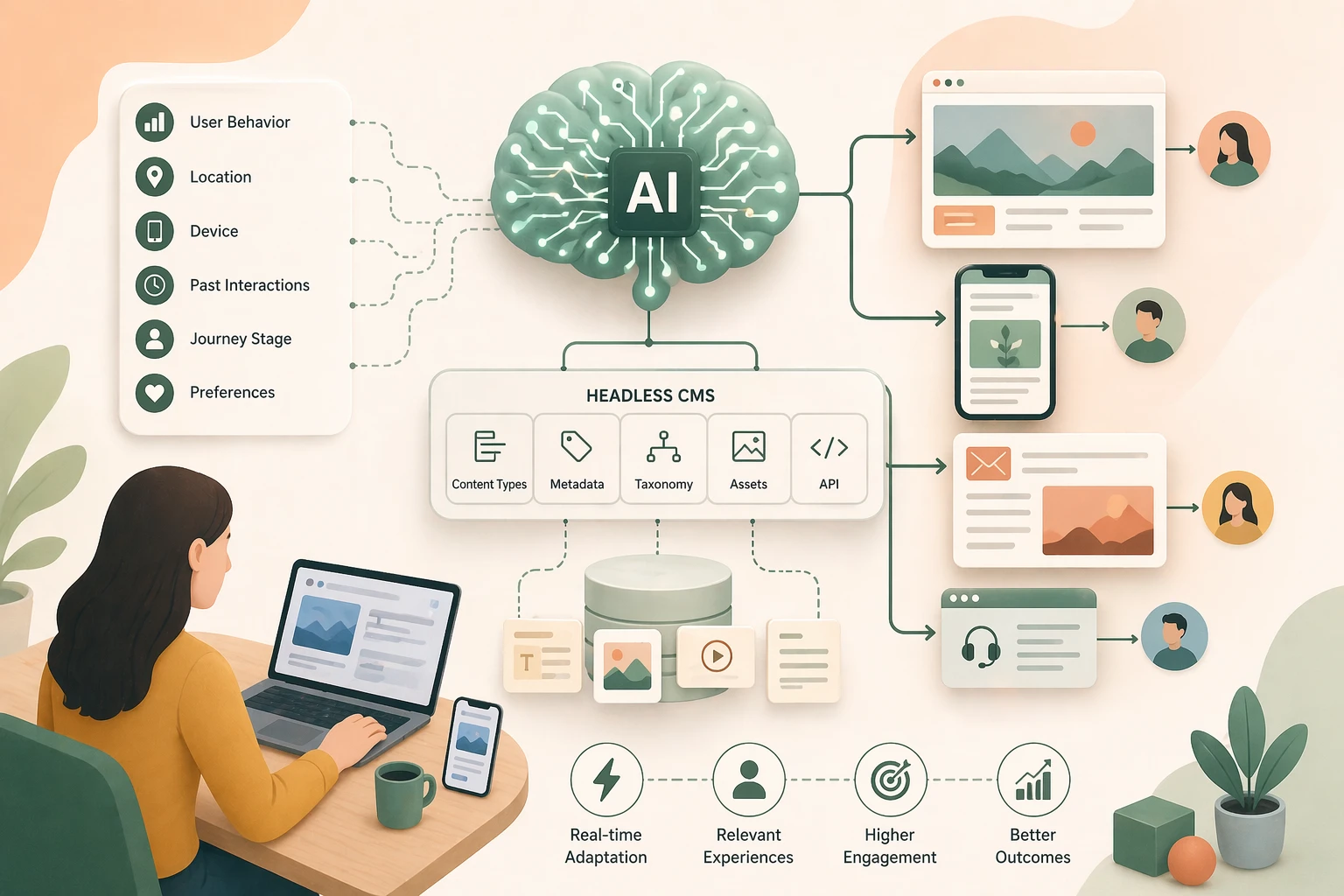
This is where the combination of AI and headless CMS becomes especially powerful. A headless CMS gives businesses a flexible content foundation by separating content from presentation and storing it as structured, reusable data. AI then uses that content foundation to make faster and smarter decisions about what should be shown, when it should be shown, and to whom it should be delivered. Instead of relying on one fixed page for every visitor, businesses can create experiences that adapt in real time based on live signals and structured content logic.
The result is a much more responsive digital environment. Users get content that feels more relevant in the moment, while businesses gain a more efficient way to manage personalization at scale. This shift is not just about improving engagement. It is also about building digital systems that can respond intelligently to behavior as it happens.
Why Real-Time Customization Matters More Than Static Personalization
Static personalization can still create value, but it often relies on broad audience rules that do not fully reflect how people behave in the moment. A business may show one version of a page to new visitors and another to returning users, but that approach remains limited because it assumes that everyone within the same segment needs the same experience. In reality, user intent can change quickly. Someone may begin with general interest, then move into comparison behavior, and finally show strong purchase or support intent within the same session. A static setup often struggles to respond to those shifts with enough speed or relevance. This is where solutions such as Storyblok and Astro become relevant, as they support more flexible content delivery that can better adapt to changing user intent and more dynamic digital experiences.
Real-time customization matters because it allows the experience to adapt while the user is still active. This can make content feel more helpful, reduce friction, and increase the chance that the next piece of information actually supports the next step in the journey. It also helps businesses move beyond one-size-fits-most segmentation toward something more responsive. Rather than assuming what a user needs based only on their category, the system can respond to current behavior and immediate context.
This is especially valuable in complex digital journeys where timing matters. If the experience adapts too slowly, the moment of relevance can already be gone. Real-time customization helps close that gap and creates a much stronger link between user intent and content delivery.
How Headless CMS Creates the Flexibility AI Needs
AI can only customize experiences effectively if the content system gives it enough flexibility to work with. In traditional page-based systems, content is often tightly tied to templates and layouts, which makes it difficult to swap, reorder, or assemble content dynamically in response to live behavior. A headless CMS changes this by storing content separately from presentation. Instead of treating a webpage as one fixed object, it treats content as a set of structured assets that can be delivered across many channels and interfaces through APIs.
This flexibility is essential for AI-driven customization. It means the system can pull a specific summary, recommendation block, help article, product highlight, or onboarding message without having to rebuild an entire page. Content becomes modular and reusable, which gives AI more freedom to respond to user signals in real time. The experience can shift based on what the user is doing rather than being limited by one static page design.
A headless CMS also supports consistency while allowing flexibility. The same content asset can be reused across multiple channels while still remaining connected to a central source of truth. That gives AI a cleaner content environment to work in and makes customization much more manageable at scale. Without this structural flexibility, real-time adaptation tends to remain shallow or operationally difficult.
Structured Content Gives AI More Useful Signals
Real-time AI customization depends not only on access to content, but on understanding what that content actually is. This is where structured content becomes especially important. In a headless CMS, content is usually organized into defined content types, fields, metadata, taxonomies, and relationships. A title is a title, a summary is a summary, a product category is distinct from an audience tag, and a support guide can be clearly separated from a promotional asset. This gives AI a much more precise view of the content library.
That precision matters because AI needs meaningful signals to make useful decisions. If the system knows that one asset is introductory, another is product-specific, and a third is designed for post-purchase support, it can choose content based on actual purpose instead of just broad popularity or rough text similarity. Structured content helps AI match user intent to the right kind of information instead of simply choosing what seems most active overall.
This leads to better customization because the content itself carries clearer context. AI does not have to guess as much. It can work with content that is already categorized and described in ways that align with business needs and user journeys. That makes real-time decisions more accurate and the resulting experience more relevant.
Using Behavioral Data to Adapt Content in the Moment
One of the biggest strengths of AI is its ability to interpret behavior quickly and use that interpretation to guide immediate decisions. In a real-time content environment, behavioral data may include what pages a user visits, how long they stay, what they click, which topics they return to, what they search for, or how far they progress through a journey. These signals help the AI understand what the user may need next, but those signals only become useful when there is a content system capable of responding in a flexible way.
A headless CMS supports that response by making content available in smaller, structured pieces that can be selected dynamically. If a user repeatedly explores comparison content, the system may surface deeper evaluation materials instead of introductory messaging. If another user shows signs of confusion by revisiting support-oriented resources, the experience may shift toward help content, clarifications, or guided answers. This creates a more natural journey because the digital experience can adjust while the session is still active.
The key advantage is that the system is not waiting for a later campaign or a future session to become relevant. It is using live signals to improve what the user sees now. That is what makes real-time customization feel genuinely intelligent rather than merely rule-based.
Metadata and Taxonomy Improve Real-Time Decision Making
Metadata and taxonomy are often treated as behind-the-scenes content details, but they are crucial for real-time AI customization. AI may recognize user behavior patterns, but it still needs a reliable way to understand which content assets match those patterns. Metadata provides the descriptive attributes that make this possible, while taxonomy creates the classification system that keeps those attributes consistent. Together, they help AI determine not just what content exists, but what role that content should play in a given experience.
For example, a content asset may be tagged by product line, lifecycle stage, audience type, region, topic cluster, or level of complexity. If a user’s behavior suggests early-stage research, the AI can prioritize educational assets with the right metadata. If the user is returning and showing high intent, the system can surface more specific or action-oriented content. Without strong metadata and taxonomy, AI often has to rely too heavily on surface signals and broad assumptions, which weakens relevance.
In a headless CMS, these descriptive layers can be built directly into the content model. That makes them much easier to maintain and much more useful in live decision-making. The result is a personalization engine that is not just reactive, but also context-aware in a more reliable way.
Real-Time Customization Across Multiple Digital Touchpoints
Users rarely stay in one channel from beginning to end. They may first discover a business on a website, continue in an app, revisit through email, and later use a support portal or account area. If customization only works well in one environment, the broader experience still feels disconnected. A major advantage of headless CMS is that it gives AI one content foundation that can support customization across multiple digital touchpoints without requiring every channel to manage content separately.
This matters because real-time relevance should not disappear when the user changes devices or platforms. A user exploring certain content themes on the website may later need a related recommendation in the app. Someone interacting with onboarding materials in one environment may benefit from more advanced help content in another. Because the content in a headless CMS is centrally managed and reusable, AI can apply more consistent logic across these touchpoints.
This creates a more coherent experience. The user feels like the system understands their journey rather than resetting every time the channel changes. For businesses, this also improves efficiency because they can manage one content structure while still delivering highly adaptive experiences in multiple places. That combination of continuity and flexibility is one of the strongest reasons headless CMS works so well for real-time AI customization.
Measuring Whether Real-Time Customization Is Actually Working
Real-time customization only becomes valuable when businesses can measure whether it improves outcomes. It is not enough for AI to change what a user sees. Teams need to know whether those changes lead to stronger engagement, better progression, improved conversion, reduced friction, or more effective support outcomes. A headless CMS helps with this because structured content makes it easier to identify which assets were delivered, in what context, and how those choices performed.
This allows businesses to analyze more than just overall personalization lift. They can evaluate which content types work best in real-time scenarios, which metadata combinations align with stronger outcomes, and which user signals lead to useful content adjustments. This is important because not every personalized experience is equally effective. Some may improve click behavior without helping real business goals, while others may quietly drive stronger long-term outcomes such as retention or support efficiency.
By measuring these patterns clearly, teams can refine both the content strategy and the AI logic behind it. The goal is not just to personalize more often, but to personalize more effectively. A structured headless CMS environment makes that learning process much stronger because the content layer is measurable in ways that static page systems often are not.
Why Headless CMS Is the Best Foundation for Real-Time AI Experiences
Headless CMS enables AI to customize user experiences in real time because it provides the exact combination of structure, flexibility, and scalability that intelligent delivery systems need. It treats content as modular data rather than fixed page output, which allows AI to select and assemble experiences more dynamically. It supports metadata and taxonomy that improve matching accuracy. It creates a central source of truth that can power multiple channels while still adapting content to the user’s current context.
This foundation becomes more important as businesses grow more dependent on personalization. Static pages and simple segmentation rules are not enough when users expect relevance across every stage of the journey. Real-time AI experiences require content systems that can respond without creating operational chaos. A headless CMS makes that possible by giving AI cleaner assets, stronger context, and more delivery flexibility from the start.
In the end, this is about more than personalization technology. It is about building a digital content environment that can learn, adapt, and respond as user needs change. Headless CMS is the best foundation for that because it turns content into something AI can actually use in a meaningful way. When that happens, customization stops being a manual layer added on top of content and becomes part of how the whole experience is designed to work.